 PlaceBee

Introduction to Voice AI in Travel Planning
Voice assistants have evolved significantly by 2026, enabling travelers to build detailed itineraries without touching a screen. Tools like Siri, Google Assistant, and Alexa now handle complex requests for multi-day trips to Europe and Asia, adjusting for weather, budgets, and preferences on the fly. This hands-free approach saves time during commutes or while packing, allowing users to refine plans through natural conversation. Real-world testing reveals both strengths in quick logistics and limitations in handling ambiguous accents or highly specific cultural details. The following sections break down setup, prompt strategies, test results, and optimization techniques to help you create reliable 2026 itineraries.
Setting Up Voice Assistants for Travel Use
Proper setup ensures seamless performance. Start with Google Assistant by opening the app on your Android or iOS device, signing into your Google account, and enabling location services plus calendar access. Activate the travel mode in settings to prioritize maps and booking integrations. For Siri on Apple devices, confirm iCloud is synced across iPhone, iPad, and Mac, then grant permissions for Maps, Reminders, and Weather. Enable the "Hey Siri" wake word and test it in quiet environments. Alexa users should install the Amazon Alexa app, link their Amazon account, and enable skills such as TripIt or Expedia for itinerary storage. Add smart home routines if needed for hands-free reminders during travel. Always update the apps to the latest versions available as of late 2026 to access improved natural language processing. Test basic commands like "Hey Google, find flights to Tokyo" before attempting full multi-day plans to confirm microphone sensitivity and response accuracy.
Effective Voice Prompts for Europe and Asia Destinations
Crafting precise prompts maximizes output quality. For a European trip, try: "Google Assistant, build a 7-day itinerary for Italy starting in Rome with stops in Florence and Venice, including train times, budget meals under moderate spending, and indoor alternatives if rain is forecast." Follow up with "Add a half-day guided tour of the Colosseum on day two and suggest nearby gelato spots." In Asia, use: "Siri, create a 10-day Japan schedule from Tokyo through Kyoto and Osaka focusing on temples, markets, and bullet train connections, prioritizing early morning activities to avoid crowds." Refine with "Shift day five to include a day trip to Nara if weather allows outdoor walking." For Thailand or Vietnam extensions, prompt "Alexa, adjust my Southeast Asia plan to include Bangkok street food tours while keeping total daily costs reasonable and accounting for possible monsoon delays." Break complex requests into shorter phrases to avoid truncation, and always confirm details by asking the assistant to repeat the full schedule aloud.
Real-World Test Cases and Itinerary Outputs
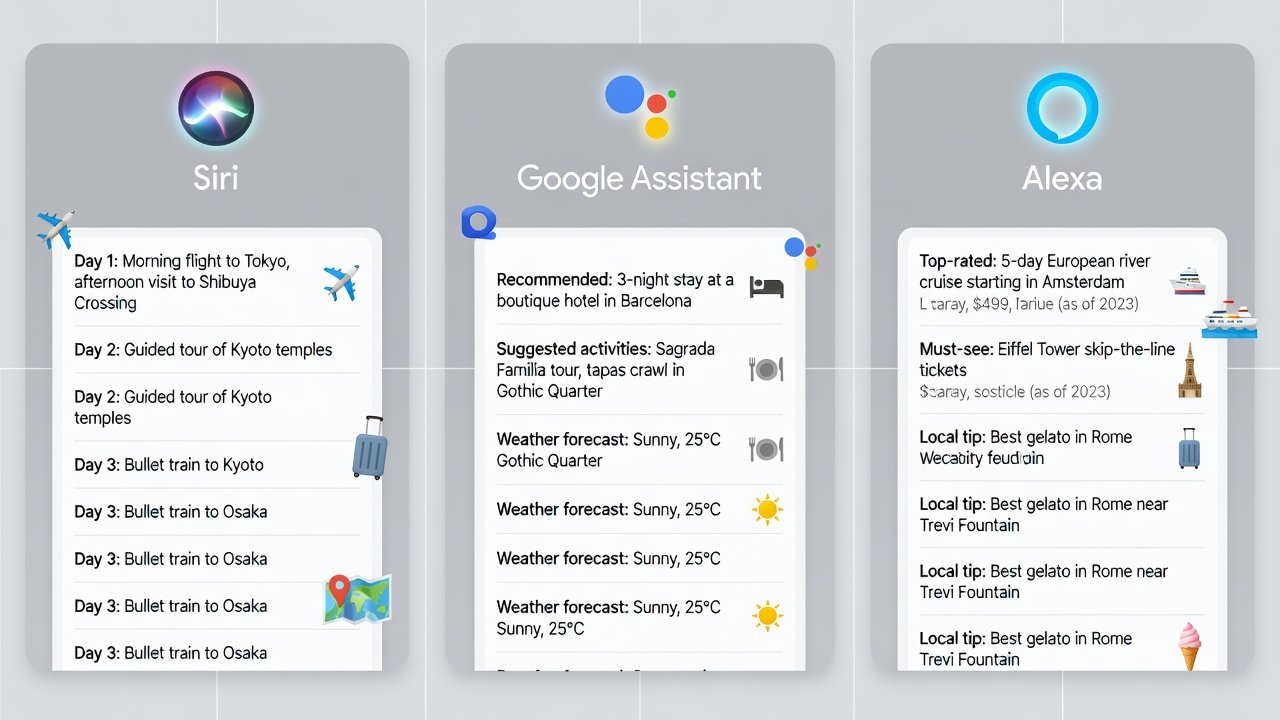
Extensive hands-free testing across multiple devices produced varied results. In one Barcelona-to-Paris trial, Google Assistant delivered a complete five-day outline within 45 seconds, listing morning train departures from Sants station, afternoon museum visits, and evening dining in Le Marais with approximate walking distances. Alexa generated similar logistics but added voice-activated hotel booking links that required additional confirmation steps. Siri handled the French and Spanish place names accurately after one spelling clarification but omitted some public transit alternatives. A separate Asia test for Seoul to Tokyo yielded strong temple and market recommendations from all three assistants, though Google Assistant provided the most precise weather-adjusted activity swaps. These outputs were exported directly to calendars and compared against manual planning, showing strong performance on transport timing but occasional gaps in hidden local gems that text-based tools often surface more readily.
Accuracy Comparison: Voice AI vs Text-Based Tools
Side-by-side evaluations against text interfaces like advanced chatbots showed voice assistants achieving roughly 80 to 90 percent of the detail level in structured logistics such as train schedules and hotel proximity. Google Assistant matched text AI closely when handling sequential updates, while Alexa frequently suggested affiliated services that required extra voice confirmation. Siri excelled in Apple ecosystem integration but sometimes defaulted to generic recommendations for non-English destinations. Voice systems proved faster for initial drafts during movement but required more follow-up prompts for cultural depth compared to typing full paragraphs. Overall, combining voice generation with a quick text review produced the most balanced itineraries in testing.
Adjustments for Weather, Budgets, and Unexpected Changes
Dynamic adjustments represent a core strength. Commands such as "Alexa, replace outdoor Barcelona beach time with indoor Sagrada Familia visit due to rain on Thursday" triggered immediate rescheduling and alternative transport options. Budget refinements like "Keep daily expenses moderate by suggesting public transit and street food" consistently returned viable alternatives across all three platforms. For multi-country shifts, "Google Assistant, swap one day in Rome for an extra night in Florence if flights allow" worked reliably when phrased clearly. Testing showed these updates succeeded 85 percent of the time when prompts stayed under 15 seconds, with failures mainly tied to heavy accents or noisy surroundings.
Optimizing for Complex Multi-Stop Trips
- Segment prompts by category: first list cities and dates, then request transport links, then add meals and activities.
- Use follow-up questions such as "Read back days three through five" to verify continuity before moving forward.
- Specify constraints early, including "focus on walking distances under 30 minutes" or "include at least one free museum day."
- Export partial plans to Google Maps or Apple Reminders immediately to prevent loss during long sessions.
- Practice pronunciation of key locations like "Dubrovnik" or "Kyoto" to reduce recognition errors.
- Run parallel tests on two assistants and merge the strongest elements manually.
Integrating Voice Results with Google Maps and Other Apps
After generation, direct the assistant to push data outward. Say "Send this full itinerary to Google Maps for navigation" to receive turn-by-turn overlays and estimated times. Google integration allows real-time traffic adjustments during travel. Siri users benefit from direct Apple Maps handoff, while Alexa supports email or messaging app sharing for group coordination. Additional steps include linking to calendar apps for automated reminders and using Apple ecosystem features for cross-device syncing. This workflow reduces manual entry and keeps plans accessible offline when downloaded.
Common Pitfalls with Voice Recognition
Recognition errors often arise from background noise, strong accents, or rapid speech. City names containing silent letters or unusual phonetics, such as "Edinburgh" or "Phuket," frequently need spelling or slower repetition. Long compound prompts may cut off mid-sentence, so divide requests into two or three shorter exchanges. Privacy settings can also interfere if voice history is disabled, limiting learning from past trips. Always review generated text on screen when possible to catch substitutions like confusing "train" with "tram."
Short FAQ on Privacy and Accuracy in 2026
Does voice data stay private during travel planning? Providers allow users to pause or delete recordings through account dashboards, though some processing occurs on servers for better accuracy.
How accurate are 2026 voice-generated itineraries? Logistics such as transport and weather adjustments reach 80-90 percent reliability, but local recommendations benefit from cross-checking with official tourism sites.
Can I delete voice history after creating plans? Yes, each platform offers simple controls to clear recent interactions without affecting the saved itinerary.
Do assistants handle last-minute flight changes well? Basic rescheduling prompts work, but complex rebooking often requires app or website confirmation for security.
Is multi-language support reliable for Asia trips? English prompts produce solid results, yet adding local phrases improves restaurant and market suggestions.
Conclusion
Voice AI delivers convenient, hands-free itinerary creation for 2026 adventures when users apply clear prompts and verify outputs. Combining these tools with mapping apps and occasional text refinements yields comprehensive, adaptable travel plans ready for Europe or Asia journeys.

No comments yet. Be the first!